

|
HOW TO READ AND FOLLOW A RECIPE There is a proverb that says “if you can read you can cook”. Whilst not entirely true, it illustrates a fundamental of successful cooking: read the recipe from start to finish, well in advance of commencing food preparation. There are four good reasons for this: 1. You obviously need to ensure you have all the ingredients before you commence. Sometimes ingredients are “hidden” in the method of a recipe, so ensure you read the entire recipe when compiling your shopping list. There is nothing more frustrating and stressful than having to dash to the grocery store in the middle of the cooking process! 2. Timing - most important in the planning process. For example,
you may be preparing a fruit cake that requires the sultanas
to be soaked overnight, or a chicken dish that requires marinating
for at least 6 hours following by a long slow cook. You’ll
save yourself unnecessary stress if you are well prepared and
know how much time to allow yourself. When entertaining, I always
recommend writing a time plan indicating times for preparation
and cooking – it is a great guide to remind you what you
need to do and when! 4. You need to determine whether you understand the cooking processes and techniques, and whether you possess the necessary skills to follow the recipe. If you are feeling adventurous, you can reference any cooking terms you are not familiar with in advance. Otherwise select a recipe that is within your limitations. Most recipes start with the ingredient list, and list the ingredients in the order they are used. Be aware of measurements of ingredients – there is a big difference between ½ cup of parsley and ½ cup chopped parsley. If the recipe calls for ½ cup chopped parsley, you will need to chop the parsley before measuring it. Australian recipes use the following measurements: 1 teaspoon = 5 ml When using American and British cookbooks, recipes use different measurements, so you will need to adjust the quantities as follows: American: British: Many recipes call for weighted quantities. I recommend the use of digital scales, particularly when baking where the quantities are more critical. A final word on measurements: it’s ok to be relaxed about measurements in most recipes – after all, cooking is about creativity not rigidity. However, any recipe that involves baking (cakes, biscuits, pastries, bread, etc) generally requires more accuracy when it comes to measurement and for this reason I do recommend the use of scales and cup and spoon measures. I would also apply this principle when entertaining, particularly if you’re using a recipe for the first time. To ensure cooking proceeds smoothly, it is recommended that the ingredients are prepared first. This is known as mise en place, a French term meaning “everything in its place” and is a culinary term that refers to preparing and pre-measuring ingredients ahead of time. For example, dice the onions, weigh the flour, grate the cheese, etc, before you start the cooking process. Preparing the mise en place ahead of time allows you to cook without having to stop and assemble items, which is particularly desirable in recipes with time constraints or when preparing more than one recipe simultaneously. Cooking temperatures are important, particularly oven temperatures. Most modern recipes are tested using a fan forced oven, so if you are using a conventional oven, add 10 degrees to the cooking temperature. Similarly, if you are using an older recipe and you have a fan-forced oven, reduce the stated cooking temperature by 10 degrees. If you are unsure, most modern cookbooks will state whether the temperatures are applicable to a fan-forced or conventional oven. Always ensure you preheat your oven (allow at least 15 minutes) before you commence cooking.
|
|||
A
final note: do remember that in most cases a recipe is a guide
– experiment, be creative and add your special touch! |
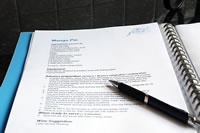 Always ensure you read the recipe in advance |
||





